Chuikov’s “Jeweler”: The Life and Legacy of Guards Major Viktor Belfer

Updated: Mar 25

Pictured: 2 January 1943, Stalingrad. In the foreground, wearing a sheepskin coat, is Viktor Belfer. Chuikov knew him personally and nicknamed him "Jeweler" because he was an excellent marksman.
The life and service of Guards Major Viktor Rakhmilyevich Belfer—whom Marshal Chuikov reportedly nicknamed “Jeweler”—embody the precision, composure, and mastery of a soldier whose effectiveness lay in skill, discipline, and deliberate action. Born in Odessa in 1919 and drafted into the Red Army in 1938, Belfer was a career artillery officer whose wartime journey spanned nearly every major phase of the Great Patriotic War. From the opening hours of 22 June 1941, when he faced the German invasion near Grodno, through the brutal defense of Moscow, Belfer’s journey ultimately converged with Chuikov’s command at Stalingrad—carrying forward through the inferno of that battle and on to the final assaults in Berlin. His path was defined by stamina, adaptability, and an unrelenting drive forward.
From the very beginning of the war, Belfer served as the commander of a fire platoon under Yakov Dzhugashvili [Stalin’s eldest son – MK], and he spoke highly of him. In those chaotic early days, when the regiment was cut in two and Soviet forces were thrown into disarray, Belfer found himself encircled. While Dzhugashvili was captured, Belfer fought his way out—returning to his own lines through sheer will. After undergoing an NKVD review, he continued his service, taking part in the defense of Moscow. Following hospitalization for wounds, he was sent to Stalingrad, where his performance in combat was so distinguished that it was later recorded in Chuikov’s memoir From Stalingrad to Berlin as well as in S.G. Kozyakin’s work titled Remembered by Name. Over the course of the war, Belfer earned numerous decorations, including the Order of Alexander Nevsky.
His nickname, “Jeweler,” seems especially fitting when one considers his role as an artillery commander. Belfer’s combat record reveals a leader capable of directing fire with remarkable accuracy and discipline under pressure. During the January 1945 offensive, for example, he commanded artillery support from within infantry formations, methodically dismantling enemy defenses—destroying mortar batteries, machine gun positions, fortified dugouts, and even tanks. His ability to coordinate fire broke through German defensive lines while protecting advancing Soviet infantry, reducing losses and maintaining momentum. This level of calculated precision—striking exactly where needed, when needed—captures the essence of a “craftsman of war,” one who shaped battlefield outcomes with deliberate and measured force rather than brute chaos.
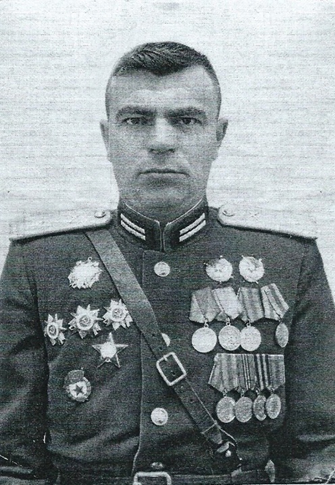
Pictured: Viktor Belfer, Commander of the 157th Guards Artillery Poznan Red Banner Regiment, 74th Guards Rifle Lower Dnieper Order of Bohdan Khmelnitsky Division, 29th Guards Rifle Lodz Red Banner Corps, 8th Guards Order of Lenin Army, 1st Belorussian Front
Yet Belfer’s story extends beyond technical skill and into resilience. Wounded and shell-shocked multiple times throughout the war, he repeatedly returned to the front. He endured encirclement early in the war and fought his way back to Soviet lines, passed scrutiny, and continued to serve. At Stalingrad, where Chuikov’s leadership demanded both courage and proximity to danger, Belfer distinguished himself to such a degree that his actions were later recorded in wartime accounts and memoirs. His experience was marked by close brushes with death—moments where survival seemed improbable, including an instance of unexploded ordnance landing within inches of him—reflecting both the peril he faced and the resilience that carried him through.
What makes Belfer particularly compelling in the context of Chuikov’s command is how closely he embodied the leadership culture of the 8th Guards Army. Officers were expected to lead from the front, remain embedded with their soldiers, and make rapid, decisive judgments under extreme conditions. Belfer’s presence in forward combat formations and his ability to direct artillery in fluid, high-risk environments reflect this ethos. His actions during the fighting in Poznań—especially the destruction of fortified urban positions and the suppression of enemy strongpoints to enable infantry assaults—demonstrate tactical competence along with a deep understanding of combined arms warfare in one of its most difficult forms: close-quarters urban combat.

Pictured: Page 312 of Chuikov’s memoir titled From Stalingrad to Berlin. In it he wrote the following account: “To destroy the enemy stronghold at the Krasny Oktyabr factory headquarters [in Stalingrad-MK], Sokolov's assault group was forced to breach the main wall. They did this using a 122-millimeter howitzer, which they had dragged disassembled and piecemeal into the occupied part of the building. There, they reassembled it and put it to use.
After several point-blank shots, a breach was created in the wall, and that was the end of the Nazi garrison there.
This operation with a 122-mm howitzer was carried out by the commander of the 6th battery of the 178th artillery regiment, V. R. Belfer, who reached Berlin and is now teaching in the Vinnytsia region.”
After the war, Belfer’s life followed a quieter, yet meaningful path. Like many veterans of his generation, he transitioned from the violence of war to the discipline of education. He completed university studies at the Physics and Mathematics Department of the Vinnytsia Pedagogical Institute after his demobilization and became a teacher. This shift—from directing artillery fire to shaping young minds—speaks to a different kind of precision and purpose. He lived modestly, carrying with him the weight of experience while choosing a life of contribution rather than recognition. He died in 2003, far from the battlefields where he had once served, but his legacy remains in both historical record and personal memory.
In many ways, Belfer represents the archetype of the soldier Chuikov relied upon—not the most famous, but among the most dependable. A man of calculation, courage, and tenacity, whose steady hand in the chaos of war earned him decorations—including the Order of the Red Banner—and the respect of those who served alongside him. The nickname “Jeweler” remains a fitting tribute—an acknowledgment of a soldier who understood that, even in war, precision could be the difference between failure and breakthrough, between loss and survival.
***Special thanks to Lydia Belfer Spivak, daughter of Guards Major Viktor Belfer, for her contribution and review. Viktor’s legacy lives on in his family, as one of his great-grandsons is named for him.***


Comments