Chuyanov and the Workers Battalions of Stalingrad: From the Factory to the Front


Pictured: Twice Hero of the Soviet Union Colonel-General V. I. Chuikov (center) with the First Secretary of the Stalingrad Regional Committee Alexey Chuyanov (left) and General of the Army Andrey Yeryomenko (right), 1945.
As we continue exploring the individuals whose lives and experiences intersected with Marshal Chuikov’s work, it is essential to highlight Alexey Semenovich Chuyanov (1905–1970). He emerged from humble beginnings in the Kuban region to become one of the central organizing figures in the defense of Stalingrad. Born into a large working-class family, Chuyanov's early years as a shepherd, laborer, and fisherman instilled in him a deep connection to the people he would later help mobilize in a time of national crisis.
His early work in the Komsomol and Communist Party sharpened his abilities in organization, communication, and political coordination. By 1938, he had risen to the position of First Secretary of the Stalingrad Regional and City Committees, placing him at the heart of the region’s political and industrial life. Even before the war, he demonstrated resolve and integrity by initiating reviews of unjust cases during the years of mass repression.
With the German invasion, Chuyanov assumed the role of Chairman of the Stalingrad City Defense Committee. While commanders such as Chuikov directed combat operations at the front, Chuyanov oversaw the rapid conversion of industry to wartime production—facilitating the output of T-34 tanks, coordinating equipment repairs, and maintaining essential supply systems. At the same time, he helped organize civilian evacuations, supported internal order, and strengthened the city’s capacity to resist under relentless pressure.

Pictured: Alexey Chuyanov, 1943, Stalingrad.
In his memoir titled From Stalingrad to Berlin, Marshal Chuikov offers a vivid account of this effort. He describes how the City Defense Committee became a vital extension of the Front Military Council, driving coordination between the rear and the battlefield. In the factory districts, workers formed battalions drawn from the Tractor Plant, Krasny Oktyabr, Barrikady, and other enterprises—men who stepped directly from production lines into defensive positions.
Across the city, party organizations and military structures worked in unison to rally the population, sending hundreds of communists to the front lines while confronting any signs of panic with firm resolve. In the most critical sectors, communists led by example through action:
“During the days of grave danger, the city's party organization worked especially hard. The City Defense Committee, under the leadership of Comrade A.S. Chuyanov, First Secretary of the Regional CPSU Committee, became the fighting force of the Front Military Council. Workers' battalions were formed in the factory districts to defend their plants. These battalions, composed of workers from the Tractor Plant, Krasny Oktyabr, Barrikady, and other enterprises, stood up in defense of their city.
The city and regional party organizations, as well as the army, under the leadership of the Front Military Council and the Political Directorate, launched a broad and tireless campaign among the masses aimed at the swiftest possible defeat of the enemy. Hundreds of communists went to the front, to the front lines of battle. At the same time, a merciless fight was waged against any manifestation of panic or cowardice. Communists were at the forefront, in the most crucial sectors of the battle.
Below I present a document that was of great importance in the defense of the city.
Appeal of the City Defense Committee, headed by the Secretary of the Stalingrad Regional Committee, Comrade A.S. Chuyanov
‘Dear comrades! Dear Stalingraders! Once again, just like 24 years ago, our city is experiencing difficult days. The bloody Nazis are rushing into sunny Stalingrad, to the great Russian river Volga. Stalingraders! We will not surrender our native city to the desecration of the Germans. Let us all rise as one in defense of our beloved city, our home, our beloved family. Let us cover every street with impassable barricades. Let us make every house, every block, every street an impregnable fortress. Come out and build barricades. Barricade every street. In the terrible year of 1918, our fathers defended Tsaritsyn. We, too, will defend the Red Banner Stalingrad in 1942!’
‘Everyone, build barricades! Everyone who can bear arms, defend your hometown, your home!’" (81-82)
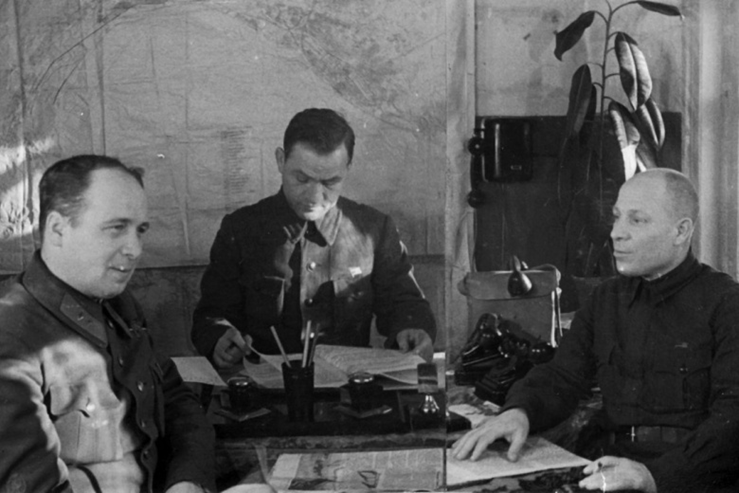
Pictured: The Stalingrad City Defense Committee. From left to right: A. I. Voronin, A. S. Chuyanov (chairman), and I. F. Zimenkov. 1942.
Chuyanov’s influence was equally evident in his appeal to the citizens of Stalingrad—a call that captured both urgency and unity. He urged residents to transform their surroundings into a fortress, to raise barricades across streets and neighborhoods, and to defend their homes with the same determination shown by earlier generations. His message carried a simple but powerful conviction: the defense of the city belonged to everyone.
Serving on the Military Councils of multiple fronts, he acted as a bridge between political coordination and military necessity. His work reveals a broader truth about Stalingrad—success rested on the combined strength of those fighting at the front and those sustaining the struggle behind it.
In later reflections, Chuyanov emphasized that the victory was shared widely—among soldiers, workers, civilians, and even children who contributed to the defense of their home. This perspective closely mirrors the leadership philosophy of Marshal Chuikov, grounded in collective effort and human resilience.
In recognition of his contributions, Chuyanov was named an Honorary Citizen of Volgograd in 1970. His legacy stands as a reminder that unyielding resolve in war depends on effective battlefield command and the ability to organize, sustain, and inspire people in the face of overwhelming adversity.


Comments