Honoring Culture, Restoring Order: Chuikov’s Postwar Service in Thuringia

Updated: Apr 6

Pictured: Colonel General V.I. Chuikov dressed in his ceremonial Victory Day uniform, 1945.
In the immediate aftermath of Germany’s surrender in 1945, the Allied powers confronted the formidable challenge of transitioning from total war to structured administration. On 24 June 1945, the Soviet Union marked victory with a grand military parade in Moscow’s Red Square—an event symbolizing both triumph and the beginning of a new, uncertain chapter. Following the celebration, Marshal Georgy Zhukov, Colonel General Vasily Chuikov, and their comrades returned to Germany to undertake the demanding work of restoring order and guiding a defeated nation through occupation and recovery.
High-level planning quickly followed, as Soviet, American, and British leaders convened under Zhukov’s direction to coordinate control of Berlin and surrounding territories. A report dated 29 June 1945 reveals the complexity of these efforts: troop levels, withdrawal timelines, territorial transitions, and staging locations all required careful alignment. Beyond military positioning, the discussions extended into logistics—transportation routes, communication systems, air access, and the management of displaced persons and prisoners of war. Agreements on key corridors, especially through Magdeburg, emphasized the need for precision and cooperation, even as uncertainty remains over access and resources.
Within this framework, Vasily Ivanovich emerged as an active participant in Allied coordination. At the request of General Lucius Clay for a Soviet liaison to meet with General Omar Bradley at his headquarters in Wiesbaden, Chuikov was selected to travel from Dresden to carry out the mission. His assignment reflects the practical realities of postwar leadership, where communication across former wartime alliances was essential to maintaining stability. This interaction required clarity, discipline, reliability, and order during a fragile transition period.
By July 1945, Chuikov’s responsibilities expanded as he assumed leadership within the Soviet Military Administration in Thuringia. Here, his role extended beyond military command into the realm of governance. Acting under Zhukov’s authority, he oversaw the formation of a new state administration, appointing leaders from multiple political backgrounds, including the Communist Party, Social Democratic Party, and Centre Party.
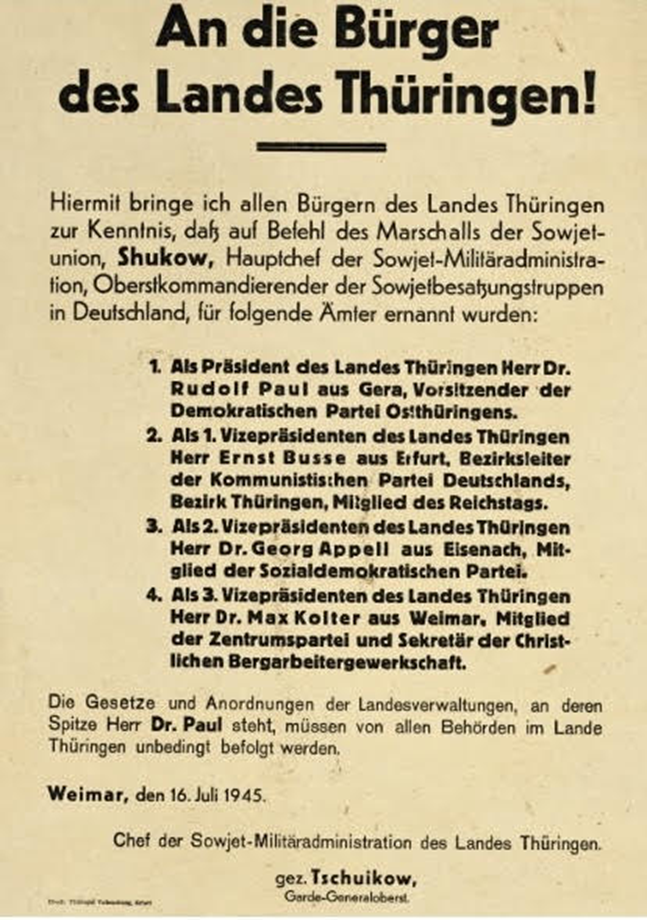
Translation: To the Citizens of the State of Thuringia!
I hereby inform all citizens of the State of Thuringia that, by order of Marshal of the Soviet Union Zhukov, Chief of the Soviet Military Administration, Colonel-Commander of the Soviet Occupation Forces in Germany, the following have been appointed to the offices of:
1. As President of the State of Thuringia, Dr. Rudolf Paul from Gera, Chairman of the Democratic Party of East Thuringia.
2. As First Vice President of the State of Thuringia, Ernst Busse from Erfurt, District Leader of the Communist Party of Germany, Thuringia District, Member of the Reichstag.
3. As Second Vice President of the State of Thuringia, Dr. Georg Appell from Eisenach, Member of the Social Democratic Party.
4. As Third Vice President of the State of Thuringia, Dr. Max Kolter from Weimar, Member of the Centre Party and Secretary of the Christian Miners' Union
The laws and orders of the state administration, headed by Dr. Paul, must be strictly obeyed by all authorities in the state of Thuringia.
Weimar, 16 July 1945
Chief of the Soviet Military Administration of the State of Thuringia
[Signed by] Chuikov,
Guards Colonel General
This deliberate structure reflected a clear emphasis on legitimacy and administrative continuity. Through formal proclamations and directives, Chuikov reinforced expectations of compliance and order. In a region marked by uncertainty, his approach provided a framework for stability—ensuring that governance emerged from deliberate organization.
Yet Chuikov’s leadership in Thuringia cannot be understood solely through administrative or military actions. In August 1945, at the historic resting place of Johann Wolfgang von Goethe and Friedrich Schiller in Weimar, he delivered remarks that reveal a deeper dimension of his command.
Addressing officers and soldiers, Vasily Ivanovich emphasized the Soviet Union’s respect for German cultural heritage, directly countering wartime narratives of destruction. He affirmed that the Red Army stood as a protector of cultural monuments and intellectual traditions. In honoring Goethe and Schiller—figures synonymous with humanism, freedom, and justice—Chuikov positioned the Soviet presence within a broader cultural and moral framework.
According to Jochen Staadt, German political scientist and author of "Nikolai Bersarin: Contemporary History and the Formation of Legends,” Chuikov’s words were deliberate and symbolic:
“‘In the name of the Red Army, which has saved the civilization of Europe from fascist barbarians, in the name of the Stalingrad Guards and the Soviet Military Administration, I lay these wreaths at the graves of the great German poets and thinkers Goethe and Schiller, fighters for the triumph of freedom and justice.’”
Marshal Chuikov’s leadership in Thuringia reflects the evolving demands placed upon military commanders in the aftermath of war. His actions reveal a figure capable of moving seamlessly between operational coordination, governmental organization, and cultural engagement. Within the broader Allied framework established by Zhukov and his counterparts, Chuikov demonstrated a disciplined and adaptive approach—one grounded in structure, clarity, and purpose.
His example challenges simplified portrayals of wartime commanders as figures defined solely by conflict. Instead, Chuikov emerges as a leader who recognized the complexity of peace: the necessity of cooperation, the importance of institutional stability, and the power of culture in shaping a nation’s recovery.


Comments