Systems Theory of Management: The 8th Guards Army as a Learning Organization

Updated: Jul 29
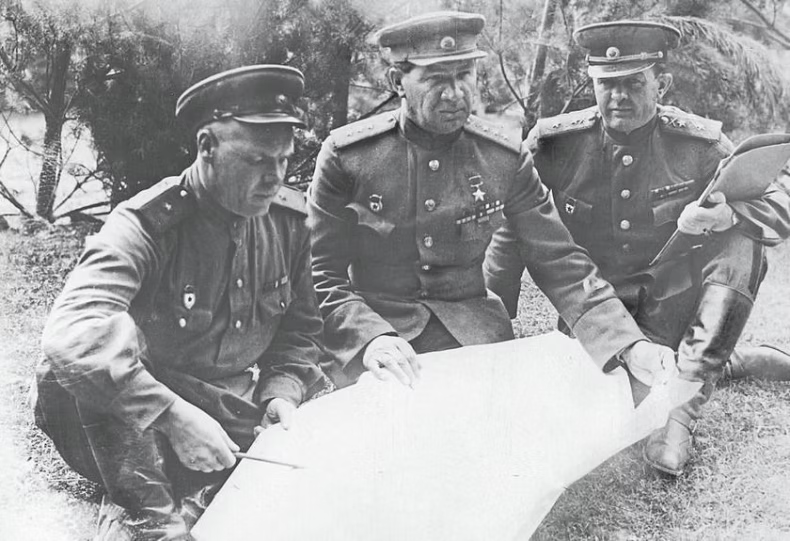
Pictured: Colonel General V.I. Chuikov reviewing strategies with Major General A.M. Pronin (left) and Lieutenant General N.I. Pozharsky (right). Chuikov was photographed wearing his first Hero of the Soviet Union gold star (No. 1958), which was awarded to him on 19 March 1944.
In a recent article written by Jason Gordon, Systems Theory of Management is explained in this way. An organization is composed of interrelated and interdependent sub-systems. Systems are affected both internally (by the actions of their subunits) as well as externally (by environmental factors). For the system to be open, organizations must receive inputs from other systems in numerous forms. In contrast to a closed system, an open system is impacted by variables. An organization, for example, may receive human resources and raw materials. Such inputs are then transformed into outputs through employee management and activities to produce products and services, which in turn influence other systems.
Building on the Systems Theory, organizational development researcher Pete Senge introduced the construct of the “learning organization”—a living, breathing organism comprised of people who contribute to achieving objectives. Organizations must learn for their survival. It has always been the case that the only way to thrive is to consistently learn faster than competitors. Glenn Cunningham and Charles Allen explained the link between Senge’s theories and the Army Organizational Life Cycle Model (AOLCM) in their chapter titled “Applying Clausewitz and Systems Thinking to Design”:
“The use of system-thinking models helps members understand complex problems and develops shared team understanding while suggesting ways to leverage the problems and identify and test solutions―all processes that support learning organizations. Senge’s insights apply to the armed services, which are undeniably large, stratified organizations composed of systems within systems.
The AOLCM depicts the linkage of systems for acquiring, developing, employing, and then retiring resources. A vivid example of the AOLCM in action is personnel—the Army recruits, trains, and educates people, then assigns them to perform missions until they are eventually released from service. Some may naively believe that such a personnel system is a simple linear process, but in truth, it is inherently convoluted and complex. […] Any theater of war presents a complex array of intermixed physical, geographical, psychological, social, political, and economic factors such that experts have long recognized that military operations must be approached from a systems perspective.” (247, 249)
Organizational learning for the 62nd-8th Guards Army reflected a successful cycle of understanding and activity. Max Visser posits that human action “lead[s] to more effective knowledge, which in its turn should lead to more effective action.” Over time, Chuikov’s 62nd-8th Guards Army was forged into an elite fighting force that was able to exploit the weaknesses of the German Army. In Stalingrad, Vasily Ivanovich and his troops were able to neutralize German advantages by significantly reducing the area of “no man’s land,” which discouraged German pilots from bombing the front lines for fear of hitting their own soldiers. Also, Chuikov’s “storm groups”—squads composed of swift-moving troops armed with guns and grenades battling in buildings ruined by strategic bombing—were particularly effective in defending the city.
Daniel Welch, who was a contributing author to the Red Army re-enactment manual, shared the following insights in cementing organizational learning during the war:
"Between battles, the Red Army conducted rigorous training, from squad level all the way up. This may be as basic as drills out of the manual, or as complicated as rehearsing assault group actions in destroying German strongpoints. Units would expend large quantities of ammunition at live fire ranges, often using captured enemy vehicles as targets, with veteran soldiers teaching new soldiers vehicle weaknesses and the best aiming points. When teaching new soldiers, veterans were also used extensively to explain what they could expect in combat and proven methods of carrying out tasks.”


Comments