The Last Congress: Marshal Chuikov and the Passing of a Generation

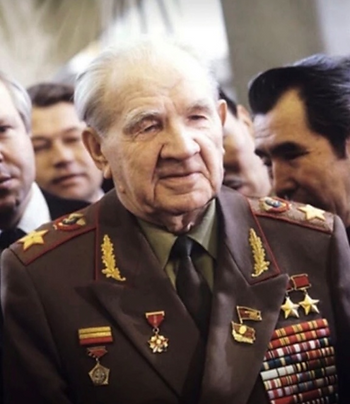
Pictured: Marshal Chuikov at the 26th Congress of the Communist Party in Moscow, February-March 1981. He was a member of the Central Committee, and he also attended as a Delegate and a Deputy of the Supreme Soviet. For more information on the lapel pins Chuikov wore, visit here.
In February 1981, Marshal Vasily Ivanovich Chuikov attended the 26th Congress of the Communist Party of the Soviet Union in Moscow. The Congress was an important gathering in Soviet political life, bringing together thousands of delegates to consider the direction of the Party and the country. For Chuikov, although no one could have known it at the time, this would be his final Party Congress.
Held from 23 February through 3 March 1981, the Congress brought together 5,002 elected delegates, with 4,994 ultimately able to attend. An additional 123 representatives came from communist parties and closely aligned organizations around the world, a considerably larger international presence than at the previous Congress in 1976.¹ The proceedings followed an established structure, beginning with Leonid Brezhnev’s report and continuing with discussions of economic and social development, foreign policy, Party affairs, and the election of the Soviet Union’s senior Party leadership.²

Pictured: “Our Goal is Communism!” poster commemorating the 26th Congress.
For Chuikov, the gathering came near the end of a life that had spanned extraordinary changes in Soviet history. He had joined the Bolshevik Party in 1919, fought during the Russian Civil War, risen through the ranks of the Red Army, and emerged from the Great Patriotic War as one of the Soviet Union’s most celebrated commanders. By 1981, the generation surrounding him had changed dramatically. Of the 5,002 delegates elected to the Congress, 4,271 had joined the Party after the war. Just 270 had become members before 1941, while the remainder had joined during the war years.³ Chuikov belonged to a rapidly diminishing generation whose experiences reached back to the formative decades of the Soviet state.
The memory of the Great Patriotic War remained visible throughout Soviet public life, and it appeared in the proceedings of the Congress as well. Brezhnev reported that additional benefits had been introduced for veterans and emphasized the continuing honor and care afforded to those who had served during the war.⁴ For Chuikov, whose name had become inseparable from Stalingrad and the eventual advance to Berlin, these references carried a personal resonance. The battles that had defined his military career were now part of the historical foundation upon which a younger Soviet generation understood its country.

Pictured: Invitation ticket to the second day of the 26th Congress given to Comrade Ksenia Matveyevna Drozdova for a balcony seat, 1981.
At the same time, the Congress was deeply concerned with the possibility of a very different kind of war. Peace, nuclear weapons, military balance, détente, and relations between the Soviet Union and the West occupied an important place in the proceedings. Brezhnev described the preservation of peace as a fundamental international responsibility and spoke of the human right to life.⁵ His report also emphasized that the Soviet Union’s defense capabilities had grown during the preceding five years.⁶
These themes take on particular significance when considered alongside Chuikov’s experience. He understood the consequences of war in immediate and deeply human terms. At Stalingrad, the 62nd Army had fought amid ruined factories, shattered neighborhoods, and devastated communities. After Stalingrad, the army that became the 8th Guards Army continued westward until its soldiers reached Berlin. Nearly four decades later, Chuikov was listening to discussions about a world in which another confrontation between the great powers could bring destruction on a scale beyond anything his generation had experienced.
The Soviet leadership used the Congress to emphasize military readiness alongside efforts to reduce international tensions. Brezhnev discussed proposals for military détente in Europe, arms reductions, limitations on nuclear weapons, and negotiations intended to reduce the possibility of confrontation.⁷ The Congress also reaffirmed the importance of the Warsaw Pact and expressed confidence in the ability of its joint armed forces to defend the socialist countries.⁸ Military preparedness and the preservation of peace were presented as closely connected responsibilities, a relationship that carried particular meaning for a commander whose reputation had been forged during one of history’s most destructive wars.

Pictured: Leader of the Soviet Union and General Secretary Leonid Brezhnev with Marshal Chuikov sharing a conversation during a break in the sessions of the 26th Congress.
The Congress also revealed some of the strains facing the Soviet Union as it entered the 1980s. Brezhnev acknowledged problems that included corruption, bribery, absenteeism, inefficient production, and ineffective Party propaganda.⁹ International affairs were equally complicated. The continuing Soviet presence in Afghanistan had become a source of international criticism, while political unrest in Poland raised serious concerns about stability within the socialist bloc. In discussing Poland, Brezhnev also emphasized the importance of listening to the population and confronting bureaucratic excesses.¹⁰
There was a visible sense of continuity within the Soviet leadership. The Politburo and Secretariat were reelected without a single change, leaving the average age of the Politburo at 69.3 years. Contemporary observer Leonard Schapiro interpreted the absence of leadership turnover as evidence of uncertainty surrounding political succession during the final years of the Brezhnev era.¹¹ Against this background, the presence of aging figures from earlier periods of Soviet history became particularly striking.

Pictured: Photo album with color photo of the 26th Congress of the Communist Party, 1981.
Chuikov himself was 81 years old when the Congress convened, yet his presence represented something broader than longevity. His public stature had been shaped by experiences that stretched from the Civil War through Stalingrad and Berlin and into the Cold War. He had witnessed the Soviet Union during moments of profound danger and transformation. By 1981, he was watching another generation confront its own questions about military security, economic development, international tension, and the future of the country.
The closing message of the Congress brought many of these themes together. Brezhnev described two central directions for the years ahead: the continued development of Soviet society and the strengthening of peace. He called for responsibility, discipline, initiative, and a willingness to search for new approaches as Congress decisions were translated into practical action.¹² For an old soldier who had spent much of his life confronting uncertainty through action, responsibility, and initiative, those themes provide a fitting backdrop to Chuikov’s final Congress.

Pictured: 26th Congress delegate’s materials, stenographic record, and Brezhnev’s report to the Central Committee of the Communist Party.
Marshal Vasily Chuikov died on 18 March 1982, a little more than a year after the 26th Congress concluded. In retrospect, his presence in Moscow during those winter days of 1981 is historically significance. The young Red Army soldier who had entered the revolutionary era had become an elderly Marshal of the Soviet Union sitting among delegates whose experiences belonged largely to the postwar world. Around him, the Great Patriotic War was gradually passing from lived experience into national memory.
The 26th Congress offers a revealing final scene in Chuikov’s public life. He had traveled a remarkable distance—from the upheaval of the Civil War to the ruins of Stalingrad, from the road to Berlin to the ceremonies of the late Soviet state. At his final Congress, the questions before the Soviet Union had changed, but the themes of security, sacrifice, responsibility, and peace remained familiar. Chuikov sat among the delegates as a living connection to the generation that had endured the Soviet Union’s greatest wartime test. Within little more than a year, that familiar figure would be gone, leaving his experiences to history and to the generations that followed.
Notes
1. Leonard Schapiro, “Political and Social Aspects of the 26th CPSU Congress,” The World Today 37, no. 5 (May 1981): 162. Schapiro records 5,002 elected delegates, 4,994 attendees, and 123 foreign fraternal delegates.
2. Ibid. The agenda included the Central Committee report, the Central Revision Commission report, the economic and social plan, and elections to the principal Party organs.
3. Ibid., 167. Of the Congress delegates, 4,271 had joined the Party after the war, 270 before 1941, and the remainder during the war.
4 Leonid I. Brezhnev, “Report of the Central Committee of the CPSU to the 26th Congress of the Communist Party of the Soviet Union and the Immediate Tasks of the Party in Home and Foreign Policy,” February 23, 1981, in The 26th Congress of the Communist Party of the Soviet Union (Moscow: Novosti Press Agency Publishing House, 1981). The report noted increased pensions and additional benefits for Great Patriotic War veterans.
5. Ibid. In introducing the international-policy section, Brezhnev described preserving peace as essential and connected it with the human “right to life.”
6. Ibid. The opening assessment of the preceding five-year period included the statement that Soviet defense capability had increased.
7. Ibid. The proposals discussed included military détente in Europe, negotiations on reductions in armed forces and armaments, and measures addressing nuclear weapons and international security.
8. Ibid. The report praised the Warsaw Treaty Organization and stated that its Joint Armed Forces possessed the capabilities required to defend the socialist states.
9. Schapiro, “Political and Social Aspects,” 166. Schapiro highlights Brezhnev’s acknowledgment of several domestic problems, including corruption, bribery, absenteeism, inefficient production, and ineffective Party propaganda.
10. Ibid., 165. Schapiro notes Brezhnev’s discussion of Poland and his emphasis on listening to the population and combating bureaucratic excesses.
11. Ibid., 167. The Politburo and Secretariat were returned without changes, and Schapiro calculated the average age of the Politburo at 69.3 years.
12. Leonid I. Brezhnev, closing speech to the 26th Congress, March 3, 1981, in The 26th Congress of the Communist Party of the Soviet Union (Moscow: Novosti Press Agency Publishing House, 1981). Brezhnev identified the principal directions as the building of communism and strengthening peace and emphasized responsibility, discipline, initiative, and the search for new approaches.
Bibliography
Brezhnev, Leonid I. “Report of the Central Committee of the CPSU to the 26th Congress of the Communist Party of the Soviet Union and the Immediate Tasks of the Party in Home and Foreign Policy.” February 23, 1981. In The 26th Congress of the Communist Party of the Soviet Union. Moscow: Novosti Press Agency Publishing House, 1981.
———. “Speech at the Closing of the Congress.” March 3, 1981. In The 26th Congress of the Communist Party of the Soviet Union. Moscow: Novosti Press Agency Publishing House, 1981. The official volume's contents identify the closing speech and date.
Schapiro, Leonard. “Political and Social Aspects of the 26th CPSU Congress.” The World Today 37, no. 5 (May 1981): 162–67.


Comments