"The Scout Remained a Scout": Leadership, Loyalty, and Accountability in the 8th Guards Army

Updated: Feb 28
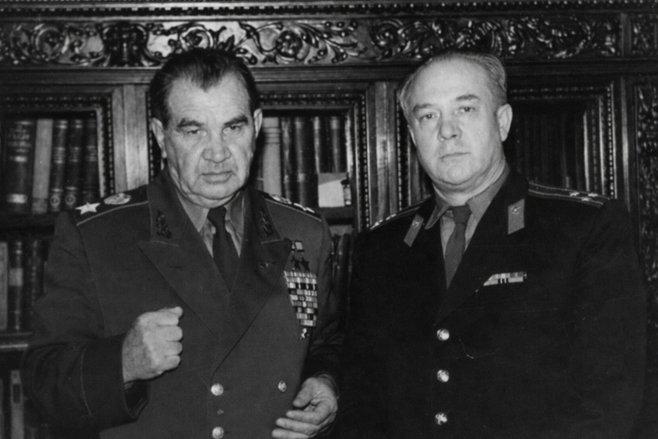
Pictured: Marshal V.I. Chuikov and the head of the intelligence department of the 62nd Army (later the 8th Guards) Colonel M.Z. German, 1960s.
There are times when an artifact inspires future research. In this case, a black and white photograph of Marshal Chuikov with Colonel German from the early 1960s caught my attention, and I wanted to learn the story behind it. After conducting a brief investigation, I found that Vasily Ivanovich wrote about the colonel in his memoir titled Stalingrad Guards Go West. After searching through a translated version of this book, I located some details about the dramatic episode in which Colonel German, then chief of intelligence of the 8th Guards Army, was wounded and captured after accidentally driving into enemy lines.
Chuikov recounts the alarm that followed at headquarters, the reprimand issued from above, and the urgent precautions taken to safeguard the army. Even more compelling was German’s conduct in captivity—severely wounded, he misled his interrogators and protected sensitive information. The photograph and the search for the story behind it revealed a powerful account of risk, resilience, and loyalty—one that deepens our understanding of both men and the bond of brotherhood they shared long after the war had ended. In Stalingrad Guards Go West, Chuikov wrote the following:
“In those days, a big trouble happened with the chief of intelligence of the army, Colonel German. Mikhail Zakharovich German passed the military path of the army essentially from the day of its creation. He was a capable, thinking intelligence officer, able not only to analyze the collected information, but also to organize it, to choose a direction for the intelligence work. And a courageous man ...

Pictured: Award List for Colonel German, signed by 8th Guards Commander
Colonel General Chuikov, 28 September 1943.
Colonel German and his assistant, Captain Chervoivanenko, were returning after a trip through the troops to the headquarters, which was then located in the village of Nezabudino. Who better than German knew the alignment of forces at the front, the location of units, the enemy's line of defense? Perhaps no one in the army headquarters. But the map and the lines drawn on the map is one thing, orientation on the terrain is quite another thing. Ukrainian steppe. There are almost no landmarks on the roads. Only a native steppe dweller is able to understand the intricacies of field roads.
The weather that day turned out to be extremely frosty, which completely changed the outline of the roads. The ruts were frozen by high dumps. They had to go in the field. It is not surprising to get lost, to allow a miscalculation in time. And they got lost. Believing that they were going to an observation post thrown out to the forward position, German and Chervoivanenko ran into the German defense. The enemy's trenches were no more than 25 meters away when they realized their mistake. German submachine gunners rose to meet them. They were probably no less surprised than our scouts.
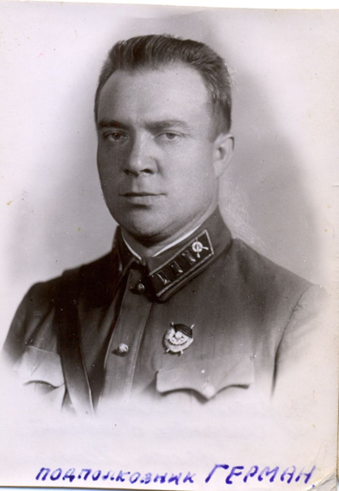
Pictured: Lieutenant Colonel German, late 1941-early 1942
- Back! Enemy! The colonel and the captain shouted almost simultaneously.
The driver Nikolai Kuchin slipped past the German trenches in a sliding arc, gave full throttle and took the car in zigzags towards our positions. The Germans opened hurricane fire. They beat down with anti-tank rifles, machine guns, mortars. Bullets pierced the car body. About two or three hundred meters, the car drove away from the German trenches. But their progress slowed down, and the car stopped. Kuchin sank down and began to slide off the seat. […]
The colonel and the captain jumped out of the car. They lay down next to it to hide from aimed fire. The steppe is flat, like a polished table. The colonel was immediately wounded. Three bullets entered the leg above the knee, one bullet - in the chest in the region of the heart, one bullet tangentially touched the head. With the help of the captain, he tried to get up, but his right leg could not hold.
- Let's crawl! The colonel ordered.
But another bullet hit and broke his right arm. The colonel fainted. He managed to order the captain to take the documents and crawl [back to HQ]. The documents of the army's chief of intelligence were of great value to the enemy. The colonel again ordered to leave. The captain could not take him out from under the shelling. […] Colonel M.Z. German was captured.
For a long time we did not know what happened to him. But this incident caused great alarm at the Headquarters of the Supreme High Command.”
As a result, a reprimand was issued to both General Malinovsky, the Front Commander, as well as General Chuikov:
Supreme Command Headquarters Order dated 23 December 1943, No. 30269
On cases of officers failing to observe safety precautions when leaving for the front lines and the punishment of those responsible
23 December 1943, 7:50 p.m.
On 16 December 1943, Colonel German, Chief of Intelligence of the 8th Guards Army Headquarters, and Senior Lieutenant Chernoivanenko, after inspecting formations, were returning by car to army headquarters, carrying a folder of documents. Having lost their bearings, the officers in question, ignoring the warning shouts of our outpost, drove at high speed, violating all driving regulations in the frontline zone, to the forward edge of our troop positions.
Fire from both sides of the front killed the driver and seriously wounded both officers. Senior Lieutenant Chernoivanenko, carrying a folder of documents, crawled to our troops and was carried behind the front lines in critical condition, while Colonel German was captured by the Germans.
Thus, it was only by chance that the documents taken with Colonel German did not fall into enemy hands.
This fact indicates that the commanders of the 8th Guards Army of the 3rd Ukrainian Front failed to comply with the Headquarters’ demands to close all roads on the front line leading towards the enemy with obstacles.
I hereby reprimand the commander of the 3rd Ukrainian Front, General of the Army Comrade Malinovsky, and the commander of the 8th Guards Army, Colonel General Chuikov, for failing to ensure that the troops under their command complied with the directive of the Headquarters of the Supreme Command No. 30239 of 7.11.19431 and my order No. 14731 of 21.10.
Headquarters of the Supreme Commander-in-Chief I. Stalin - A. Antonov
Source: TsAMO. F. 148a. Op. 3763. D. 143. L. 310
The day after receiving a reprimand from Stalin, General Malinovsky urged immediate action to correct the situation through decisive activity. He recommended relocating the army headquarters, as well as the corps and division headquarters, and reconsidering artillery positions. Although General Chuikov trusted Colonel German, he recognized that the responsibility for many lives required caution. If the Germans had forced information from the captured colonel, it could have created serious risks. As a precaution, the headquarters were moved closer to the front, and the corps headquarters were redeployed as well.
By morning, there were no signs that the enemy had received any new intelligence. Enemy aviation and artillery operated as usual, and aerial reconnaissance detected no troop redeployments. This suggested that Colonel German had either revealed nothing or had been killed. With no apparent threat, the army headquarters was moved back to Nezabudino. Chuikov continues in his memoir:
“I met Colonel German in 1945 in Berlin. He was released from captivity by the soldiers of his native 62nd - 8th Guards Army. He went through a lot. […] And with great difficulty I managed to get him to talk.
… He woke up from severe pain from hitting his head on frozen blocks of plowed land. Tying his hands with a belt over his head, he was dragged by two [German] soldiers, crawling, on their bellies, into their trenches. German lost consciousness again.
The interrogation was carried out right there, in the first line of trenches, in a dugout. He was in a semiconscious state, but nevertheless, pulling himself together and assessing the situation, he chose for himself the only possible option of behavior. He remembered that there were no documents with him, that Chervoivanenko had escaped, so he introduced himself with an assumed name, showing that he was serving as a financial inspector of the army ...

Pictured: A report confirming that Colonel German went missing in action on
17 December 1943, and that a notice was delivered to his wife in Kharkov.
He was threatened with torture, maybe death. It was necessary to immediately invent something. Colonel German made it clear to those who interrogated him that he knew only general data concerning the army. He showed that the left flank of our army is the strongest. In fact, in those days, it was the left flank, as the weakest, that caused our concern.
And here, in this terrible moment for him, the scout remained a scout - who would outwit whom.
Then the colonel was taken for questioning to the real investigator. The interrogation was carried out professionally, competently. Fearing to get entangled in contradictions, German did not answer a single question at all.
For several days the colonel was kept at the evacuation center in Kamenka. He required medical attention [but] he was denied this. He went on a hunger strike and probably would not have survived it if the Soviet girl Galya Bondarenko, who worked at the evacuation center as a nurse, had not helped him. Late at night she brought him pickles and boiled water, fed him, bandaged his wounds ... Galya Bondarenko tried to arrange an escape. His severe wounds prevented it...
I told Mikhail Zakharovich about the fate of his delegate. Captain Chervoivanenko saved the documents. He brought them to our positions, but was mortally wounded. He died a few days later. He was posthumously awarded the Order of Lenin.”


Comments