At Marshal Chuikov's Side: The Remarkable Biography of Lieutenant General Matvey Vainrub

Updated: Oct 18

Pictured: Marshal V.I. Chuikov and Lieutenant General M.G. Vainrub in Volgograd, most likely in the late 1960s or early 1970s. For more blogposts on Vainrub, see here and here.
Among the military leaders who served alongside Marshal Chuikov during the Second World War was Matvey Grigorievich Vainrub (also spelled Weinrub), a Soviet tank commander whose distinguished military career extended from the desperate defense of Stalingrad to the final campaign against Nazi Germany. As commander of the armored and mechanized forces of the 62nd Army and later the 8th Guards Army, Vainrub became one of Chuikov's trusted subordinates, demonstrating exceptional courage, tactical judgment, and determination under some of the most difficult battlefield conditions of the war.
Born on 2 May 1910, in Borisov, present-day Belarus, Vainrub grew up in a Jewish working-class family. Before entering military service, he worked as a glassblower at the Borisov Glass Factory between 1924 and 1929. He joined the Red Army in 1929 and pursued a professional military career, completing his education at the Belarusian Military School and later the prestigious Frunze Military Academy in 1941. His training prepared him for the increasingly important role of armored warfare in modern military operations.
When Germany invaded the Soviet Union in June 1941, Vainrub entered combat service, initially holding positions in tank and reconnaissance units. By the autumn of 1942, he had been assigned to the 62nd Army, commanded by Lieutenant General Vasily Chuikov, as Soviet forces struggled to defend Stalingrad against relentless German attacks. Vainrub assumed responsibility for armored operations and became an important member of Chuikov's command structure.
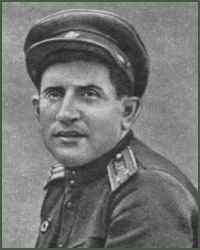
Pictured: Colonel Matvey Weinrub
One of Vainrub's most memorable actions during the Battle of Stalingrad involved the fighting near the city's Central Railway Station and the strategically important House of Specialists. As German forces attempted to break through Soviet defensive positions and reach the Volga River, Vainrub personally directed an attack against German troops occupying the building. Accounts of the fighting credit his detachment with helping secure the area and protect the river crossings used by Soviet reinforcements, including elements of the 13th Guards Rifle Division. These operations occurred during a critical period when the survival of the Soviet defense depended upon maintaining access to the eastern bank of the Volga.

Pictured: Lieutenant General Chuikov in front of Lieutenant Colonel Vainrub (right) on the banks of the Volga in Stalingrad, 1943.
Following the Soviet victory at Stalingrad, the 62nd Army was redesignated the 8th Guards Army on 16 April 1943. Vainrub continued serving under Chuikov as commander of its armored and mechanized forces. During subsequent campaigns across Ukraine and Poland, he played an important role in coordinating tank formations and supporting offensive operations. His ability to respond quickly to changing battlefield circumstances made him a valuable commander within an army known for its aggressive tactics and demanding leadership.

Pictured: General Chuikov (center) with Colonel Matvey Vainrub (center, back row) in late 1943/early 1944.
An account preserved in Vainrub's biographical materials illustrates the confidence Chuikov placed in him. During fighting in southern Ukraine, the commander of the 23rd Tank Corps, Lieutenant General Yefim Pushkin, was killed. Facing an urgent command vacancy, Chuikov selected Vainrub to assume responsibility for the formation. According to the account, Vainrub traveled by Po-2 aircraft and took command within approximately three hours, organizing resistance against the advancing German forces. The incident demonstrates the considerable trust Chuikov placed in Vainrub's judgment and ability to lead under pressure.

Pictured: Special correspondent for the Krasnaya Zvezda newspaper, Lieutenant Colonel Konstantin Mikhailovich Simonov (center) and commander of the armored and mechanized troops of the 8th Guards Army of the 1st Belorussian Front, Hero of the Soviet Union, Guards Major General of Tank Troops Matvey Grigorievich Vainrub on the steps of the main entrance to the building of the new Imperial Chancellery (Reich Chancellery) in Berlin.
Vainrub distinguished himself again during the Vistula–Oder Offensive in January 1945, directing armored formations in operations that penetrated German defensive positions near the Polish town of Magnuszew. His leadership contributed to the rapid Soviet advance across Poland and toward Germany. On 6 April 1945, he was awarded the title Hero of the Soviet Union, accompanied by the Order of Lenin and the Gold Star Medal, in recognition of his military leadership, courage, and battlefield achievements.

Pictured: Matvey Vainrub (left) with his brother Yevsey, both brothers displaying their Hero of the Soviet Union gold stars.
Vainrub's military story also includes an unusual family distinction. His older brother, Yevsei Grigorievich Vainrub, commanded the 219th Tank Brigade and likewise received the title Hero of the Soviet Union. A recollection published in Vainrub's biographical materials describes an unexpected reunion between the brothers during the Vistula–Oder campaign, when Yevsei reported to Matvey as the commander of a newly assigned tank brigade. After completing their formal military introductions, the brothers embraced. Their shared service and recognition represented an extraordinary achievement for two sons of a working-class Jewish family from Belarus.

Pictured: A personnel document indicating that Major General Vainrub (third name from the top) served on a review commission regarding the recommended discharge and retirement of a Soviet Army senior tank officer. The form was signed by Marshal Chuikov on 6 May 1958, one year before Vainrub was promoted to Lieutenant General.
After the war, Vainrub continued his military career, holding senior armored command positions and serving in the Kiev Military District while Marshal Chuikov was the Kiev Military District Commander. He was promoted to Lieutenant General of Tank Troops on 25 May 1959, and subsequently served as deputy commander for combat training in the district. He retired from military service in 1970 and later worked as a senior research associate at the Ukrainian Scientific Research Institute of Technical Information. Vainrub died on 14 February 1998 in Kiev, where he was buried at Sovskoye Cemetery.

Pictured: Inscribed copy of These Men of Steel, signed by Vainrub on Victory Day – 9 May 1988.
Vainrub also contributed to the preservation of wartime history through his published recollections, including These Men of Steel (1972), Fellow Soldiers (1982), and Frontline Destinies (1985). His writings provide an additional perspective on the experiences of Soviet armored commanders and the soldiers who fought across the Eastern Front.
Perhaps one of the most revealing aspects of Vainrub's legacy was his assessment of Chuikov's leadership. In a recollection preserved by the Jewish military history project Jewmil.com, Vainrub described Chuikov as a demanding but fair commander who evaluated his officers according to their abilities and actions rather than their national backgrounds. For Vainrub, whose Jewish heritage was an important part of his personal identity, this recognition of professional competence carried particular significance.

Pictured: Marshal Chuikov and Lieutenant General Vainrub, 1980.
The relationship between Chuikov and Vainrub illustrates the importance of mutual confidence, professional expertise, and decisive leadership in wartime command. Vainrub demonstrated the qualities that Chuikov valued in his senior officers: courage, initiative, reliability, and an unwavering commitment to accomplishing the mission. His service remains an important chapter in the history of the 62nd Army, the 8th Guards Army, and the military leaders who helped secure victory over Nazi Germany.


Comments