Marshal Chuikov’s New Year’s Greeting to Marshal of Aviation Filipp Agaltsov


Pictured: New Year’s greeting from Marshal of the Soviet Union V.I. Chuikov to Marshal of Aviation F. A. Agaltsov, congratulating him on the approaching year 1974.
Translation: Marshal of Aviation, Comrade F. A. Agaltsov
Dear Filipp Aleksandrovich! Please accept my sincere congratulations on the approaching New Year, 1974! Marshal of the Soviet Union V. Chuikov
A greeting of only a few words can reveal a much larger story. In late 1973, Marshal of the Soviet Union Vasily Ivanovich Chuikov sent a brief New Year’s greeting to Marshal of Aviation Filipp Aleksandrovich Agaltsov. Though simple in its message, the letter offers a personal glimpse into the relationship between two senior Soviet commanders whose distinguished military careers extended from wartime service into the postwar decades.
Born in 1900 in Russia’s Tula Region, Filipp Aleksandrovich Agaltsov grew up in poverty in Tsarist Russia, entering the Red Army in 1919. His career eventually became closely associated with Soviet military aviation. Agaltsov served in Spain during the Spanish Civil War and, during the Great Patriotic War, commanded aviation formations that participated in major operations including the Battle of Kursk, the crossing of the Dnieper, and the Korsun-Shevchenkovsky operation. In 1944, he assumed command of the 1st Polish Mixed Aviation Corps. By the spring of 1945, his formation was operating with the 1st Belorussian Front and participated in the final campaign against Germany, including the Battle of Berlin.
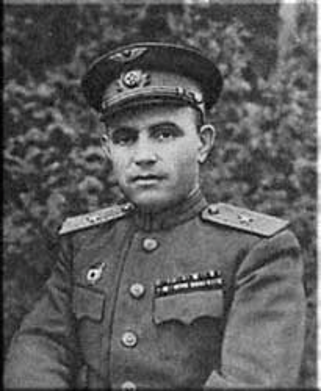
Pictured: Major General of Aviation Agaltsov during the Great Patriotic War
This period provides an important connection between Agaltsov and Chuikov. Chuikov’s 8th Guards Army was also part of the 1st Belorussian Front during the advance through Poland and the final assault on Berlin. Although the two men commanded very different military organizations—Chuikov a ground army and Agaltsov an aviation formation—their commands contributed to the larger combined-arms effort that culminated in the defeat of Nazi Germany.
Both men continued to hold significant positions after the war. Agaltsov commanded the 16th Air Army and later served in several senior Soviet Air Force positions. Beginning in February 1958, Agaltsov served as Deputy Commander-in-Chief of the Soviet Air Force for Combat Training, later also becoming Chief of Air Force Combat Training in December 1960. In this role, he contributed to the development of the training program for the Soviet Union’s first group of cosmonauts and supported the selection of cosmonaut candidates from among military pilots. His connection to the early Soviet space program extended to Yuri Gagarin’s historic flight on 12 April 1961. Agaltsov was present at Gagarin’s landing site following his return to Earth and accompanied him during his celebrated arrival in Moscow two days later.

Pictured: Yuri Gagarin with Marshal Agaltsov
From 1962 to 1969, Filipp Aleksandrovich Agaltsov commanded Soviet Long-Range Aviation and served as a member of the Air Force Military Council. On 28 April 1962, he was promoted to the rank of Marshal of Aviation by decree of the Presidium of the Supreme Soviet of the USSR. After retiring in 1969, Agaltsov returned to military service in 1971 as a member of the Group of Inspectors General of the USSR Ministry of Defense. His long career was recognized in 1978 when he received the title Hero of the Soviet Union.
At the time the note was written, nearly three decades had passed since the battles of 1945, yet the greeting demonstrates that connections among members of this generation of Soviet commanders continued long after the war had ended. For the study of authentic leadership, documents such as this offer another perspective on Chuikov. His leadership story is most often examined through Stalingrad, the 8th Guards Army, and Berlin, but leadership also exists through relationships maintained over time and further demonstrates his warmth and humanity.

Pictured: Marshal of Aviation Agaltsov
By the time this letter was written, Chuikov and Agaltsov had become senior representatives of a generation whose experiences were already passing into history. Agaltsov died in 1980, and Chuikov followed in 1982. Their New Year’s correspondence therefore survives as a small but meaningful artifact from the later years of their lives—a reminder that behind the great military campaigns were individuals whose professional relationships continued after the battlefield had fallen silent.


Comments