An Authentically Transformational Leader

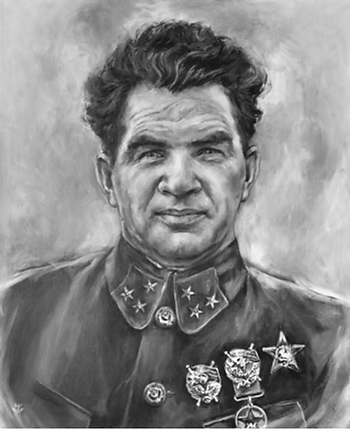
Image: “General Storm,” a portrait of Lieutenant-General V.I. Chuikov created by Muscovite artist Maria Kozlova, 2023.
Organizational leaders often seek the most effective way to engage their employees, foster cohesive working relationships, lift morale, and increase productivity. According to leadership expert Kevin Ford, there are three effective leadership styles:
“Tactical leaders focus on solving straightforward problems with operations-oriented expertise. Strategic leaders are very future-focused with an ability to maintain a specific vision while forecasting industry and market trends. Transformational leaders focus less on making decisions or establishing strategic plans, and more on facilitating organizational collaboration that can help drive a vision forward.”
Transformational leadership, the third type identified by Ford, is also known as the relationship theory because of the strong focus on the collaboration between leaders and their team members. Based on anecdotal evidence from authentic leader Marshal Chuikov’s memoirs and articles as well as what his peers and subordinates wrote about him, it is safe to say that he was adept at all three of these effective leadership styles and was most certainly a transformational leader. In his book Stalingrad: How the Red Army Triumphed, author Michael Jones shared the following remarks, which support my stance on Vasily Ivanovich's effective leadership:
“Vasily Chuikov summed up the enemy that he faced at Stalingrad with brutal simplicity: ‘The Germans were smart, they were tough and there were a lot of them!'
Facing them was a Russian force that had only just come into being. The 62nd was one of Russia's youngest armies. In the summer of 1942 it was poorly trained, badly equipped and largely demoralized. On the approaches to Stalingrad it was hammered by the Germans and many of its divisions were smashed to pieces. But yet, in the ruins of the city, the battered remnants found the will and courage to confront their assailants and turn the tables on them.
Something remarkable happened at Stalingrad. At the outset of the battle the Germans held all the military advantages. But as one British newspaper, the Daily Telegraph, noted at the end of September 1942:
‘It is, indeed, something more than material conditions, something that transcends the pure mechanics of war, that is involved at Stalingrad. It is the great imponderable morale that has turned a defensive with so many handicaps, a defensive, moreover, that seemed spent, into this astounding episode that is clearly baffling the German Command.’
The tale of the Russian defenders at Stalingrad transcends time and place. It tells of astonishing resilience and a triumph in the face of overwhelming odds. Morale and motivation transformed the 62nd Army into a fighting force of stupendous power. In private conversation, Vasily Chuikov discarded communist rhetoric to express a truth every soldier at Stalingrad would have understood: 'When a person is pushed to his very limits, and he realizes there is absolutely nowhere else to go - then they really have to start fighting!'”


Comments